
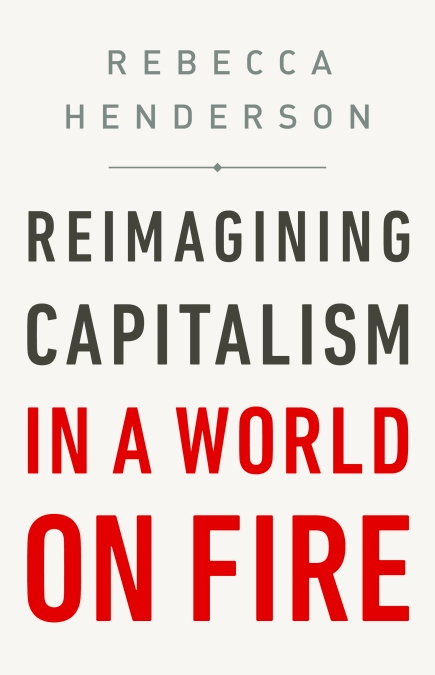
These are my notes and favorite highlights from the book Reimagining Capitalism In A World on Fire (2020) by Rebecca Henderson. One of my graduate school electives, Sustainable Business Models, is based on her work. I’ll share three excerpts, three suggestions from the author, and three personal reflections and action points.
Three Excerpts
On the scalability of purposeful firms: “The firms that mastered change were those that had a reason to do so: the ones that had a purpose greater than simply maximizing profits. People who believe that their work has a meaning beyond themselves can accomplish amazing things, and we have the opportunity to mobilize shared purpose at a global scale.”
On a firm’s sphere of responsibility: “Many managers are persuaded that to claim any other goal is to risk not only betraying their fiduciary duty but
also losing their job. They view issues such as climate change, inequality, and institutional collapse as “externalities,” best left to governments and civil society.
On free markets gone wild: “The problem is not free markets. The problem is uncontrolled free markets, or the idea that we can do without
government, and without shared social and moral commitments to the health of the entire society on which effective government depends.”
Three Suggestions From The Author
- Sustainability can be more expensive, but consumers are willing to pay more if the product “ticks all the right boxes” in quality, price, and functionality. A firm needs to find a way to make this work.
- Investors are concerned about the bottom-line (vs. the triple-bottom-line of people, planet, and profit). Firms must persuade investors that the right thing is the profitable thing.
- When building business cases about sustainable endeavors, treat them as a strategic hedge and not as a “leap to the unknown.”
Three Personal Reflections
- While sustainability requires an orchestrated, mass movement, I can start with my sphere of influence. I am fortunate that my current job description requires looking for sustainability pathways in the energy industry. However, sustainability is not just about the environment. Part of the triple-bottom-line is people and is something that one can have a readily available action item. Treating people fairly can be a good start.
- Sustainability can be too complex to comprehend, especially for the masses (the primary customers of billion-dollar businesses). Being an advocate of the sustainability movement is also telling simple stories that can drive action. As a marketing professional, I must craft compelling marketing materials that inspire action and change despite the 1) high probability of higher costs both to the vendor and to the consumer; and 2) shift from the traditional or comfortable zone.
- Make “lobbying” a good thing. This term has a negative connotation, especially in the oil & gas industry. However, lobbying has its merits when it has good intentions. Reimagining Capitalism is synonymous with Reimagining Public Governance. The private sector needs to do its share in pushing its sustainable agenda.
 Migo Aguado
One thought on “Reimagining Capitalism”