
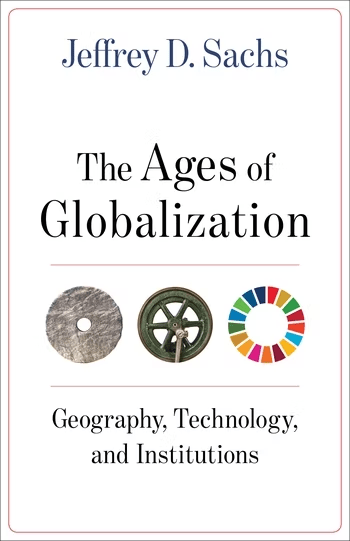
These are my notes and favorite highlights from the book The Ages of Globalization: Geography, Technology, and Institutions (2020) by Jeffrey D. Sachs. I’ll share three excerpts, three suggestions from the author, and three personal reflections.
Three Excerpts
On addressing Globalization: “Throughout history, it has been important to understand the threats arising from globalization (disease, conquest, war, financial crises, and others) and to face them head-on, not by ending the benefits of globalization, but by using the means of international cooperation to control the negative consequences of global-scale interconnectedness.”
On the aspiration to find a common framework: “Is there a common framework that could engage communities across the divisions of faith, culture, race, and ethnicity? Our answer, tentatively, is yes… The faith leaders and ethicists identified three moral precepts common to all of the world’s faiths. The first is the Golden Rule, the principle of reciprocity: Do not do unto others what you would not have them do to you.”
On the problem in The Anthropocene Epoch: “The conundrum is how easily we nonetheless fall prey to our small differences, which can be stirred into virulent hatreds by demagogic leaders in their quest for power. The great evolutionary biologist E. O. Wilson is no doubt correct when he notes that we have stumbled into the twenty-first century with our ‘Stone Age emotions, medieval institutions, and godlike technology.’ We are out of synch, out of kilter.”
Three Suggestions From The Author
- Divisiveness and parochialism can be traced in our evolutionary history. However, our instincts and medieval behavior cannot be of help in a globalized world. “By understanding our common history and our common vulnerability, we can also grasp our common interests and values. In that way, we can find a path to shared prosperity and peace.”
- Human impact should be lessened while maintaining or improving total prosperity through technology and behavioral change. “The human impact is equal to the population times GDP/population * impact/GDP.”
- The globalized world’s sustainability initiatives could be the most extraordinary human challenge of our history. Just like any approach to any challenge, planning is vital. “In this regard, we should consider the very wise statement of President Dwight D. Eisenhower, who served as the supreme allied commander in World War II. Eisenhower liked to say that “plans are useless, but planning is everything.” He meant that specific plans would not be followed in practice because unexpected circumstances would surely arise. Yet, planning—the logical process of looking ahead systematically—is crucial for success.
Three Personal Reflections
- Global Politics can make or break humanity’s survival on our planet with finite resources. Through country associations and economic fora, regional and global cooperation can synergize sustainability initiatives. However, as the quest for political and economic power remains a priority for individual nations, their attempts to synergize will never be maximized. Governments continue to represent nations, and it’s about time that the civil society becomes more active in a) peacefully pressuring governments to have material global cooperation and b) organizing international civil society movements.
- I’m not a big fan of religions, but I acknowledge their merits as an institution. In civilizations, these institutions complement the state’s law enforcement duties by being an “invisible police.” The author argued that despite the differences in the religions’ schools of thought, we always find one thing in common: The Golden Rule. As key behavioral drivers for most people since their birth, religious institutions can mobilize the faithful towards a sustainable society.
- Goal #17 of the United Nations’ Sustainable Development Goals aims to “strengthen the means of implementation and revitalize the Global Partnership for Sustainable Development.” Most of the time, I feel overwhelmed with the plethora of conversations, initiatives, and partnerships different institutions try to engage in. How much is too much? Well, they’re not yet enough. Eisenhower said that “planning is useless, but planning is everything.” We may end up in a different scenario altogether vs. what we have planned initially, but it would be great to know that we have moved the dot. Start the conversations and partnerships in your spheres of influence.
 Migo Aguado