
Once taken for granted under the assumption that it’s humanly innate, storytelling has become a critical competency in humanity’s endeavors toward sustainable development: We want to urge people to participate in development initiatives through the stories we tell. Although painted with urgency, sustainability feels like a marathon mission instead of a shock-and-awe sprint. This is challenging for storytellers: stories need to be compelling enough to encourage action, and compelling stories need to feel urgent. How do we tell relatable, action-oriented stories with a long-term deadline with many protagonists? Stories need to have high stakes, highly urgent, and highly challenging, usually with a “hero” protagonist listeners are rooting for [1].
Maria Ressa, in her book How to Stand Up to a Dictator: The Fight for Our Future (2022), illustrates that journalists have the privilege and responsibility to tell these stories. While many sustainability topics revolve around carbon consumption and technological innovation, Ressa argues that journalism is the bedrock of development. Factual stories create integrity in elections. Integrity in elections creates a healthy democracy. A healthy democracy creates inclusive development.
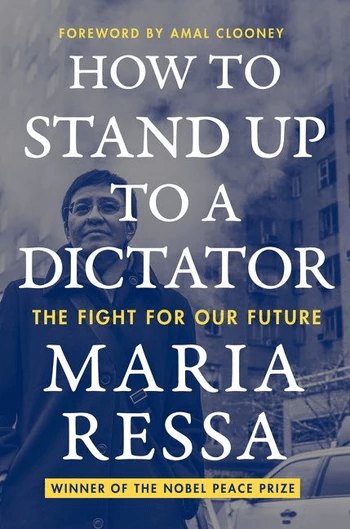
Then social media, Facebook, in particular, happened. Ressa argued: “Participation in the platforms had the effect of tweaking our emotions by increasing the dopamine levels in our brains. Because our emotions were heightened, our expectations, and the way we reacted to them, were shifting. And it was not just social media but all the technological interruptions in the modern world that conditioned us to prefer sensationalism over objectivity.[2] This is similar to how Jeffrey Sachs described the internet-savvy human in his book, The Ages of Globalization: “The conundrum is how easily we nonetheless fall prey to our small differences, which can be stirred into virulent hatreds by demagogic leaders in their quest for power. The great evolutionary biologist E. O. Wilson is no doubt correct when he notes that we have stumbled into the twenty-first century with our ‘Stone Age emotions, medieval institutions, and godlike technology.’ We are out of sync, out of kilter.” [3]
Sustainability demands firms transition from profit creation to value creation. In her book Reimagining Capitalism, Henderson argued, “our focus on shareholder value maximization is an exceedingly dangerous idea, not just to the society and the planet, but also to the health of business itself.” [4] Technology companies that scale and innovate beyond human comprehension and rationality thresholds for profit creation need to be alarmed. Facebook, among other social media platforms, has become an enabler of polarization and disinformation–in exchange for revenues worth US$ 30 billion [5]. Stories are powerful, for better or for worse. Social media thickened the plot so much that the demarcation between heroes and villains has blurred. Ressa encourages everyone to #HoldTheLine.
—
[1] Orsagh, M., & Barry, T. (2022, June 9). Storytelling: Our Future Depends on the Stories We Tell. The Sustainability Story. Retrieved December 23, 2022, from https://cfaesg.libsyn.com/storytelling-our-future-depends-on-the-stories-we-tell
[2] Ressa, M. (2022). Maria Ressa, in her book How to Stand Up to a Dictator: The Fight for Our Future. Harper.
[3] Sachs, J. (2020). The Ages of Globalization. Columbia University Press.
[4] Henderson, R. (2020). Reimagining Capitalism in a World on Fire. PublicAffairs.
[5] (2022, October 26). Meta Reports Third Quarter 2022 Results. Meta Investor Relations. Retrieved December 23, 2022, from https://investor.fb.com/investor-news/press-release-details/2022/Meta-Reports-Third-Quarter-2022-Results/default.aspx
 Migo Aguado