
Hyperindividualism permeates our modern culture through advances in precision data science, self-centrism & omnipresence of social media, and the continuous expansion of liberal and Western ideals. The clamor for understanding the Self has risen as we slowly merge with technology. Yuval Noah Harari, a historian, calls this post-human species Homo deus. He foresees humans exceeding biological limitations regarding longevity and innovation competence but argues that it could also mean we will leave our humanity behind to favor progress. To mitigate this risk, Harari argues that our best bet is to develop our emotional intelligence (Hopper, 2017)[1]. For me, emotional intelligence needs a deep understanding of the Self.
There are several schools of thought in understanding the Self. Carl Jung, an Analytical Psychologist, labels the Self as the “God within us.” Jung referred to the Self as all-embracing, including the “conscious and unconscious psyche” (Jung Society, 2020)[2]. On the other hand, Sigmund Freud, a Neurologist, labels the Self as the “ego” that sits between the id and superego. The Self is created through these opposing forces of anxiety and social conformity (Sabater, 2021)[3]. Both schools of thought are said to be etiological: the Self is caused by phenomena including but not limited to past experiences, culture, and societal norms. One psychologist, Alfred Adler, offers a different Copernican approach: teleology.
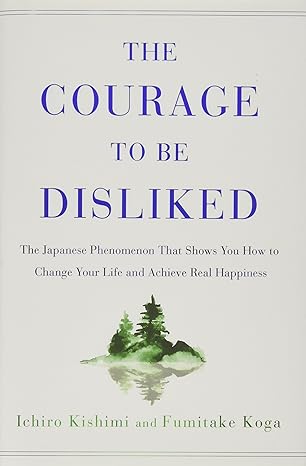
The Courage To Be Disliked, a book by Ichiro Kishimi and Fumitake Koga, explores the teleological approach to understanding the Self based on Adlerian Psychology. Teleology is a branch of causality that gives the reason or explanation for something as a function of its end, purpose, or goal, as opposed to a function of its cause (Júnior & Vasconcelos, 2011). These are my key takeaways from the book:
- The Self is sufficient and is not defined by past experiences (e.g., trauma) or the future (e.g., uncertainties). Pursuing happiness and finding life’s meaning is up and only up to the Self. This means that happiness and meaning are readily available in the present. Adler suggests to accept the Self and not to affirm the Self.
- While the Self cannot be defined without interpersonal relationships, all problems arise when we deal with “other selves” or the people around us. Adlerian Psychology suggests the “separation of tasks”: what others think doesn’t define the Self.
- The essence of work or vocation is the contribution to the common good. The Self’s worth is not hinged on external validation but the subjective feeling of community contribution.
How can Adlerian Psychology or Teleology improve our emotional quotient in a society that craves external validation and could be imminent to depart from humanity? We are all anxious, and I think anxiety has become a staple emotion in our modern workplace, interpersonal dynamics, and approaches to looking at the future. Interestingly, “living in the present” is a famous mantra but lacks a definite framework. Adlerian Psychology could offer just that. One of its critiques is its probable disregard for self-development, as it supposedly dismisses a relentless approach toward being the best version of yourself in a perceived future. However, supporters of Adler claim that Jungian and Freudian approaches to the Self could be counter-productive: fixations about the past and future uncertainties could hinder oneself from reaching an ultimate potential.
Adler’s legacy can be found in modern self-development literature:
- Stephen Covey (7 Habits of Highly Effective People): “Be Proactive is about taking responsibility for your life. Proactive people recognize that they are “response-able.” They don’t blame circumstances, conditions, or conditioning for their behavior.” [5]
- James Clear (Atomic Habits): “Pour all of your energy into the journey, be present in the moment, and be committed to the path you are walking.” [6]
- Jim Collins (Good To Great): “What was the one big push that caused this thing to go so fast?” You couldn’t answer; it’s just a nonsensical question. Was it the first push? The second? The fifth? The hundredth? No! All of them were added together in an overall accumulation of effort applied in a consistent direction. Some pushes may have been bigger than others, but any single heave—no matter how large—reflects a small fraction of the entire cumulative effect upon the flywheel.” [7]
SOURCES:
[1] Hopper, N. (2017, February 16). How Humankind Could Become Totally Useless. TIME. Retrieved September 23, 2023, from https://jungutah.org/blog/intro-to-jung-what-is-the-self/
[2] Jung Society (2020, December 29). Intro to Jung: What is the Self? Jung Society of Utah. Retrieved September 23, 2023, from https://jungutah.org/blog/intro-to-jung-what-is-the-self/
[3] Sabater, V. (2021, November 5). Freud on Developing a Strong Sense of Self. Exploring Your Mind. Retrieved September 23, 2023, from https://exploringyourmind.com/freud-developing-a-strong-sense-of-self/
[4] Júnior, Paulo Pereira Martins; Vasconcelos, Vitor Vieira (2011-12-09). Teleology and randomness in the study of the natural sciences: systems, ontology, and evolution.
[5] Covey, S. Habit 1: Be Proactive. FranklinCovey. Retrieved September 23, 2023, from https://www.franklincovey.com/the-7-habits/habit-1/
[6] Clear, J. The Goal is Not the Point. James Clear. Retrieved September 23, 2023, from https://jamesclear.com/treasure-hunt
[7] Collins, J. The Flywheel Effect. Jim Collins. Retrieved September 23, 2023, from https://www.jimcollins.com/concepts/the-flywheel.html
 Migo Aguado