
In the Filipino culture, we tend to rationalize an individual’s behavior by saying, “mabait naman siya (s/he’s actually kind).” We start or end with such a statement before or after criticizing someone’s character. This phenomenon could be primarily cultural, as Filipinos are non-confrontational and relationship-based in the culture map. Cognitive dissonance drives this culture to water down criticisms to feel better about oneself or invite mutual understanding. The idea of “good” or “kind” varies in different cultures and schools of thought. We have utilitarianism and hedonism, to name a few. While universal ethics are absent despite significant conformity to a global standard like the Universal Declaration of Human Rights, “what is ethical” is a discourse and not definite.
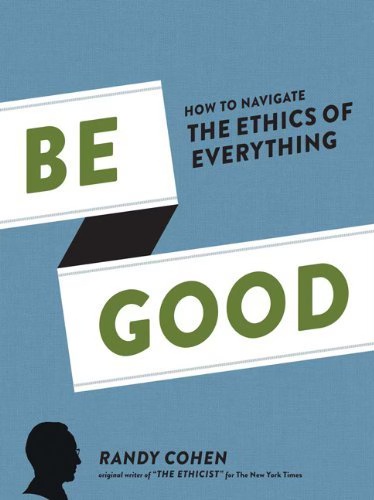
Randy Cohen, an American known as the author of The Ethicist column in The New York Times and the author of Be Good: How to Navigate the Ethics of Everything, quoted psychologist Jonathan Haidt: Moral judgment is like aesthetic judgment. When you see a painting, you usually know instantly and automatically whether you like it. If someone asks you to explain your decision, you confabulate. Moral arguments are much the same: Two people feel strongly about an issue, their feelings come first, and their reasons are invented on the fly to throw at each other. When you refute a person’s argument, does she generally change her mind and agree with you? Of course not, because the argument you defeated was not the cause of her position; it was made up after the judgment was already made.” Moral—and aesthetic—ideas alter over time, and argument is one way to effect that change.
Cohen compiled different ethical inquiries from letter senders while still with The New York Times. A wide range of topics cover family, religion, and love & sex. Arguably, these topics incite most of our ethical inquiries in daily life. These are some of my favorite and most insightful remarks by the author:
- Being ethical is taking action: Failing to resist what you see as an injustice simply because you fear you cannot win this fight assures the defeat you dread.
- Being ethical is systemic and not particulate. Ethics concerns how we act at a moment of decision and respond to the conditions that engendered that moment; ethics demands individual rectitude and civic virtue.
- Being ethical is being empathetic: To lead an ethical life requires us to empathize with others and ask, “What circumstances would induce a person to behave this way?
Aside from culture, religion is the primary driver of ethics. How do you reconcile the perceived differences in a society with increasing inter-religious conflict? Fortunately, our grade school lesson about the golden rule will be helpful. Different religions have expressed the rule while maintaining its core principle[1]. If you do not subscribe to a religion, the rule has also been described in different philosophies in different eras and geographies[2]. Lastly, I like that it forms the ethical foundation of the business principles and license to operate of most modern organizations. Sure, the enforcement of such might be questionable for some, but as mentioned, ethics is a discourse, and one should take action, view it as a system, and be empathetic.
SOURCES
[1] Normal Rockwell Museum (n.d.). Golden Rule. Retrieved December 7, 2024, from https://www.nrm.org/2018/03/golden-rule-common-religions/
[2] Unitarian Universalist Fellowship of Hendersonville (n.d.). Golden Rule. Retrieved December 7, 2024, from https://uufhnc.org/wp-content/uploads/2017/08/Golden-Rules-Marc-Mullinax-Presentation-8.20.17.pdf
 Migo Aguado