
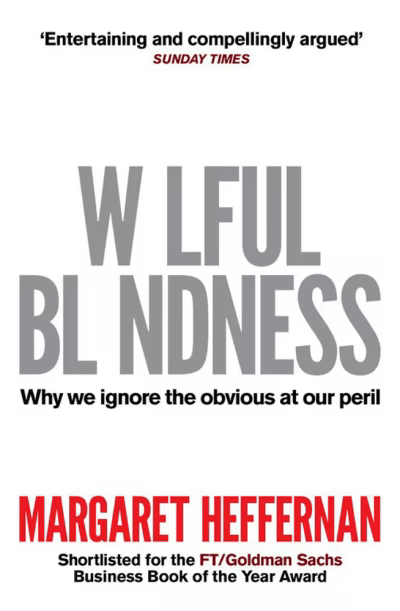
When I knew that a colleague shared the same birthday as mine, I suddenly felt an urge to befriend him even though I had virtually zero knowledge of who he was and what he was like. Familiarity, after all, doesn’t breed contempt–it breeds comfort. The book Willful Blindness (2011) by University professor Margaret Heffernan described more “comforting shortcuts” our brains make: we tend to donate more to victims of typhoons where the typhoon names are similar to ours or choose a profession with starting letters that are the same with ours. Although these phenomena feel like novelty and harmless, Heffernan described serious, deadly, and long-lasting repercussions of our shortcuts and comfort in family, business, and politics.
While reading the book, the previous literature I wrote about in my blog came into the picture:
Do Hard Things (Steve Magness). According to Magness, real toughness is experiencing discomfort or distress, leaning in, paying attention, and creating space to take thoughtful action. However, we strive to preserve an image of ourselves as consistent and stable. Our most cherished beliefs are a vital part of who we are. A challenge to these beliefs feels life-threatening, and we want to reduce the pain by ignoring evidence that proves we are wrong or reinterpreting evidence to support us. Heffernan illustrates “hard things” as those we turn a blind eye to because of our wilful blindness.
The Trouble With Reality (Brooke Gladstone). Gladstone described our reality as a “huge version of Disneyland,” where fake realities create fake humans. Fake humans, then, create versions of fake realities to be sold to other humans, “turning them into forgeries of themselves.” Gladstone’s fake realities are similar to Heffernan’s description of a “form of reality we choose to believe in” even though they are dangerously not real. We choose to live in Disneyland because most of us would rather be wrong than alone under social pressure.
The Changing World Order (Ray Dalio). Dealing with what you know and what you don’t know: a) know all possibilities, think about the worst-case scenarios, and then find ways to eliminate the intolerable ones; b) diversify well; c) put deferred gratification ahead of immediate gratification; d) triangulate among the most intelligent people. Dalio, an investor and hedge fund advisor, is looking at diversification from an investment perspective, but he does this to mitigate the risk of willful blindness. Heffernan suggests recognizing the homogeneity of our lives, institutions, neighborhoods, and friends, putting more effort into reaching out to those who don’t fit in, and seeing positive value in those who prove more demanding. Looking at any of our major institutions–from parliament to corporate boards, think tanks, and churches–that homogeneity suddenly looks like a weakness and a risk. In this context, diversity isn’t a form of political correctness but an insurance against the internally generated blindness that leaves institutions exposed and out of touch. The very fact that these groups feel comfortable should ring alarm bells.
Why Nations Fail (Daron Acemoglu and James Robinson). This synergistic relationship between extractive economic and political institutions introduces a strong feedback loop: political institutions enable the elites controlling political power to choose financial institutions with few constraints or opposing forces… Nations fail when they have extractive economic institutions, supported by extractive political institutions that impede and even block economic growth.” The elites might be running on a hedonic treadmill: the more they generate profit, the more they want to. The mere prospect of money reduced people’s (the elite’s) sense of connectedness to the community, contributing to the nation’s downfall. Heffernan says that nobody quite understands why money works the way it does. Economists have speculated that motivation may work in ways similar to cognitive load. Just as there is a hard limit to how much we can focus on at one moment, perhaps we can be motivated by only one perspective at a time. When we care about people, we care less about money, and we care about money, we care less about people. Our moral capacity may be limited in just the same way that our cognitive capacity is.
How To Stand Up To A Dictator (Maria Ressa). Then social media, Facebook, in particular, happened. Ressa argued: “Participation in the platforms had the effect of tweaking our emotions by increasing the dopamine levels in our brains. Because our emotions were heightened, our expectations and reactions to them were shifting. And not just social media but all the technological interruptions in the modern world that conditioned us to prefer sensationalism over objectivity. Heffernan wrote the book in 2011, and she hasn’t seen the worst effects of social media. However, she still offers a timely challenge: In this age of desperation to be liked, adored, and socially accepted in an expanded version of reality, where algorithms rule, and polarization intensifies, how can we celebrate the dissenters and the debaters? Their heroic dissent sets a standard for critical thinking that is more inspiring than skepticism and richer than doubt.
Yuval Noah Harari, a contemporary historian, argued that “…numbers alone don’t count for much in history. History is often shaped by small groups of forward-looking innovators rather than by the backward-looking masses.” These small groups of people chose to know, to debate, and to dissent. Heffernan ends her book with a simple suggestion: as all wisdom does, seeing starts with simple questions: what could I know, should I know, that I don’t know? Just what am I missing here?
 Migo Aguado