
Mark Bittman traces the history of food from early human societies to modern industrial agriculture, showing how the shift from diverse hunter-gatherer diets to grain-based farming fundamentally reshaped societies. Agriculture enabled surpluses and population growth but also produced inequality, elites, and systems of labor exploitation, while monotonous diets, disease, and environmental degradation became widespread consequences. Early societies were often cooperative and relatively egalitarian, but the accumulation of surplus created hierarchies and ruling classes, tying control of land and food directly to political power and social stratification.
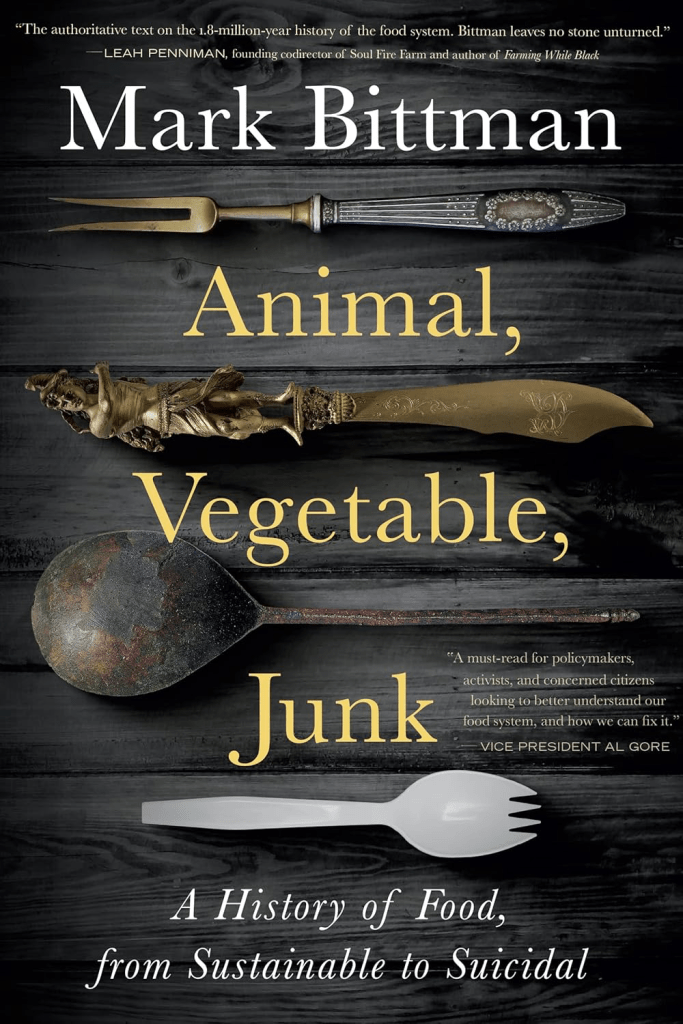
As agriculture expanded into empires and colonial systems, food production increasingly served profit and state power rather than human welfare. European colonial regimes forced enslaved or coerced populations to produce monoculture cash crops for export, stunting local economies and reinforcing dependence. Later, industrial agriculture intensified this pattern: yields and export value became the dominant metrics of success, while soil health, sustainability, and the well-being of farmers and workers were neglected. Corporations and governments shaped global diets, markets, and even national sovereignty through food aid, trade policies, and marketing, often locking poorer countries into dependency on imported grain and processed foods.
This historical trajectory closely reflects the argument in Why Nations Fail by Acemoglu & Robinson that extractive political institutions enable elites to impose extractive economic systems that inhibit broad-based prosperity. Bittman’s account shows how the pursuit of agricultural profit repeatedly created such feedback loops: states and business elites controlled land, labor, and trade, enabling resource extraction from colonies or marginalized populations while limiting their economic autonomy. The global food system thus becomes a case study in how extractive institutions operate in practice—concentrating wealth, shaping consumption, and sustaining power structures—even as they generate long-term environmental damage, inequality, and food insecurity that ultimately undermine the resilience of societies themselves.
 Migo Aguado