
The Art of Insight argues that insight is not a product of forceful analysis or memory retrieval, but a fundamentally different mode of thinking. Charles Kiefer & Malcolm Constable, principals in an innovation consulting firm, argues that modern education and work environments condition people into “memory thinking,” where solutions are sought by interrogating past knowledge, often disconnecting them from their natural capacity for fresh insight. True insights arise in an “easygoing, open, and unpressured” state of mind, where thinking is relaxed rather than fixated on problems. This state cannot be forced through rigid techniques but can be cultivated through awareness and practice. Ultimately, insight is framed as an art—something innate yet improvable through attention to how thought itself operates.
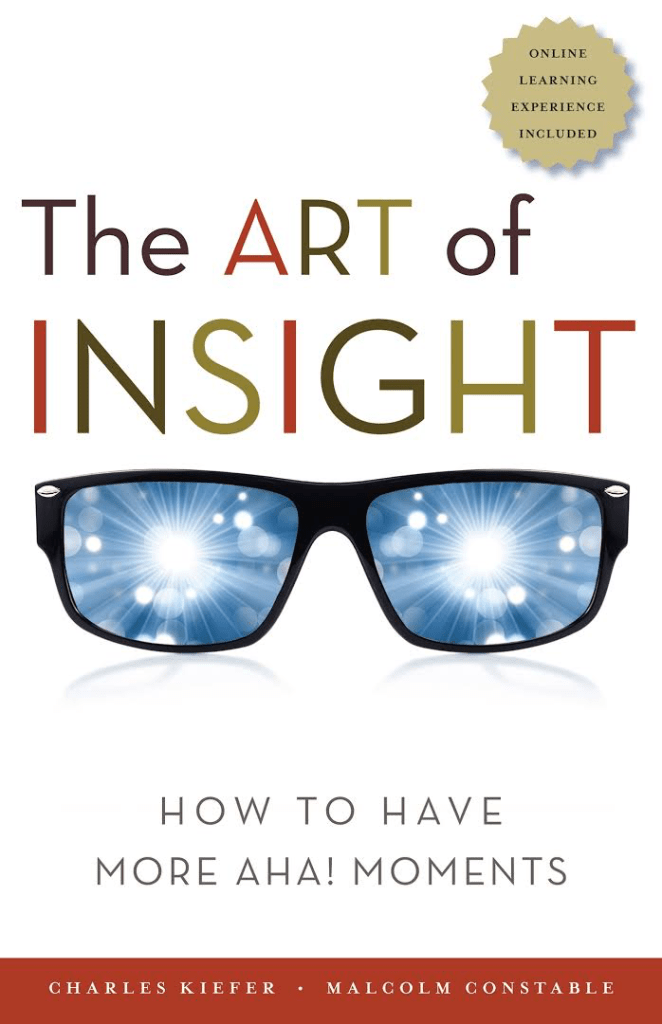
The book further explains that insights tend to emerge indirectly, often when the mind is disengaged from deliberate problem-solving. This “Insight State of Mind” is characterized by calmness, clarity, and mental spaciousness, contrasting sharply with the pressured, multitasking-heavy environments that dominate modern life. Practices like “Insight Listening” reinforce this by encouraging presence, non-judgment, and openness, allowing new thoughts to surface without interference from habitual patterns or preconceptions. Importantly, the quality of thinking (“how” we think) matters more than the content (“what” we think), as forced or clenched thinking suppresses insight even if the thoughts themselves seem productive. The creative process thus follows a rhythm of preparation, incubation, illumination, and verification, where the unconscious mind plays a crucial role in generating breakthroughs.
This framework aligns closely with Consciousness: Confessions of a Romantic Reductionist by Christof Koch, particularly his exploration of “zombie agents”—systems that can process information and act intelligently without conscious awareness. In the context of insight, the book’s emphasis on stepping back from deliberate, conscious effort mirrors the idea that much of our most powerful cognition occurs beneath awareness, akin to these zombie-like processes. When individuals enter a relaxed, receptive state, they effectively allow these unconscious “agents” to recombine information and detect patterns without interference from the analytical, conscious mind. Insight, then, can be seen as the moment when outputs from these hidden processes surface into awareness, producing the characteristic “aha” experience. By trusting and creating space for these quasi-autonomous mental processes, humans can harness the power of their own “zombie agents,” transforming passive cognition into a reliable engine for creativity and deep understanding.
 Migo Aguado