
Growing up, I was exposed to Wyeth’s successful marketing campaign for their formula milk, Promil. The Promil kids seemed to have become a benchmark of an entire generation in having a head start and are expected to be successful in their respective fields. Some kids, now all grown-up, have chosen a path different from how they were depicted in the television commercials, albeit still thriving in their own right. While I don’t know what transpired during their teenage years, the Promil kids might have the chance to do other endeavors, termed the “sampling period” by American Journalist David Epstein in his book Range: Why Generalists Triumph in a Specialized World (2019).
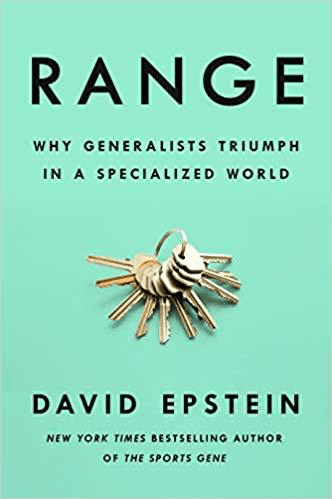
The eventual fate of the child prodigies in the marketing campaign is not isolated. They are joined by novelist Haruki Murakami, tennis player Roger Federer, triathlete Chrissie Wellington, Nintendo’s Gunpei Yokoi, basketball player Steve Nash, and Nobel laureate Tu Youyou. They could be labeled as late-bloomers, outsiders, or generalists. Unfortunately, their prominence in their respective specialized fields shadows their interdisciplinary journey.
Epstein argued that scientists and members of the general public are equally likely to have artistic hobbies. Scientists inducted into the highest national academies are likelier to have avocations outside their vocation. And those who have won the Nobel Prize are more likely still. Compared to other scientists, Nobel laureates are at least twenty-two times more likely to partake as amateur actors, dancers, magicians, or other types of performers.
Brain Coach Jim Kwik, in his book Limitless (2020), said: “Here’s the truth: It’s not how smart you are; it’s how you are smart. There are multiple types of intelligence (more on this later). Like so many things, intelligence combines attitudes and actions and depends on context. New belief: Intelligence is fluid.”
Kwik, who was able to overcome a traumatic head injury and become intelligent in his own way, forwards the concept of the fluidity of intelligence. The attitudes, actions, and context that form intelligence could be related to Esptein’s “interleaving.” He argues that for knowledge to be flexible, it should be learned under varied conditions, an approach called varied or mixed practice, or, to researchers, “interleaving.” The University of Arizona defines interleaving as a process where students mix or interleave multiple subjects or topics while they study to improve their learning. In contrast, blocked practice involves studying one topic thoroughly before moving on to another. Interleaving is more effective than blocked practice for developing the skills of categorization and problem-solving; interleaving also leads to better long-term retention and improved ability to transfer learned knowledge.
In a study of consultants and bankers, Herminia Ibarra, a professor of organizational behavior at London Business School, concluded that we learn who we are only by living and not before. She said that we maximize match quality throughout life by sampling activities, social groups, contexts, jobs, and careers and then reflecting and adjusting our personal narratives. Ibarra marshaled social psychology to argue persuasively that we are each made up of numerous possibilities. She said, “We discover the possibilities by doing, trying new activities, building new networks, finding new role models.” We learn who we are in practice, not in theory.
Here are three lessons I have reflected on after I finished reading the book:
- If you feel that you are late in life, especially in the age of social media, the odds are in your favor. If you had a headstart, that would be good for you. Or probably not, as there are significant cases in which those who did could not sustain it. Either way, you can make good use of your set of competencies to branch out to more domains.
- Diversify your domains and continue experimenting. It could be in sports, career competencies, or personal relationships. You will never know your potential in a silo.
- Don’t be afraid to fail. Failure is an integral part of learning, if not the best one.
 Migo Aguado