
Capital markets post-industrial revolution demand intense biological processes that can surpass natural limits. John Coates, a neuroscientist trader and author of The Hour Between Dog & Wolf (2012), argues that the biological storm associated with our work and lifestyle is too much for a human’s biochemical makeup. This is especially true with traders in financial markets who experience winning and losing streaks. Financial risk-taking, he argues, is a biological activity with corresponding medical consequences.
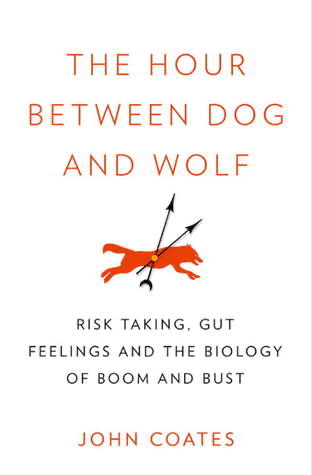
Two hormones might be directly associated with market boom and bust cycles: testosterone and cortisol. Testosterone boosts confidence and risk-taking. However, overconfidence can lead to excessive risk-taking that can cause booms and asset bubbles. On the other hand, cortisol triggers fear and uncertainty. While playing it safe can stabilize markets, growth can be hampered and even crash when no rational or positive growth-inducing intervention occurs. This is a sound proposition, but more studies should be done in other fields to have scientifically compelling guidance for traders and industries. If proven true, the traditional coursework of trading and modern management must be challenged, like the efficient-market hypothesis and slew of strategy frameworks. Coates also suggested integrating biological feedback loops in traders during trading activities and promoting stress monitoring and physical fitness as work-related activities. Lastly, Coates reinforced the importance of age and gender diversity among traders. Too many young male traders could mean an intoxicating testosterone party that can lead to market crashes.
Evolutionary biologist E.O. Wilson notes that we have stumbled into the twenty-first century with our “Stone Age emotions, medieval institutions, and godlike technology. We are out of sync, out of kilter.” We have already realized that the Industrial Revolution should not have discounted the limits of our ecology. Our prospect for continuous economic growth cannot discount the limits of our biology, especially in the age of artificial intelligence.
P.S. My favorite part in the book is when Coates describes how Daniel Wolpert, an engineer and neuroscientist at Cambridge, argued that the brain is fundamentally very practical and that its primary role is not to engage in pure thought but to execute physical movement. It’s about time to redefine “smart” or “cerebral,” yes?
 Migo Aguado