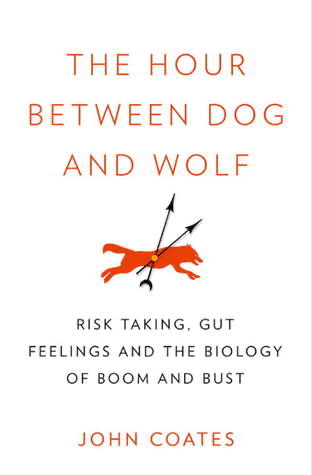
The Hour Between Dog & Wolf: Risk Taking, Gut Feelings, And The Biology of Boom & Bust

Capital markets post-industrial revolution demand intense biological processes that can surpass natural limits. John Coates, a neuroscientist trader and author of The Hour Between Dog & Wolf (2012), argues that the biological storm associated with our work and lifestyle is too much for a human’s biochemical makeup. This is especially true with traders in financial markets who experience winning and losing streaks. Financial risk-taking, he argues, is a biological activity with corresponding medical consequences.

Continue reading The Hour Between Dog & Wolf: Risk Taking, Gut Feelings, And The Biology of Boom & Bust

Do Hard Things

Different athletic disciplines illustrate various principles of openness and creating space: in basketball, we “open ourselves to the ball.” In yoga, the final pose of savasana encourages yogis to “open themselves to the abundance of the universe.” Conversely, running encourages a “controlled fall” instead of “running tall.” This will give the runner a “perpetual forward propulsion into space.” Lastly, Olympic weightlifting illustrates the “weightless bar” concept, where the barbell “floats” in mid-air after a “triple extension” so the athlete can efficiently receive it in a clean or a snatch. Sports require efficiencies rather than brute strength. Sure, strength, in its traditional definition, can be foundational and become a competitive advantage in the short term. Still, in the long term, those who thrive and win have mastered navigating through discomfort or distress and not by ignoring them through sheer strength. Steve Magness, a coach to some of the best runners in the world, challenged the traditional definition of toughness in his book Do Hard Things: Why We Get Resilience Wrong and the Surprising Science of Real Toughness. 

Continue reading Do Hard Things